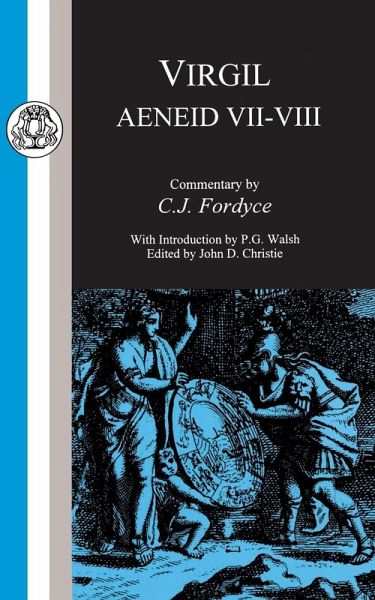
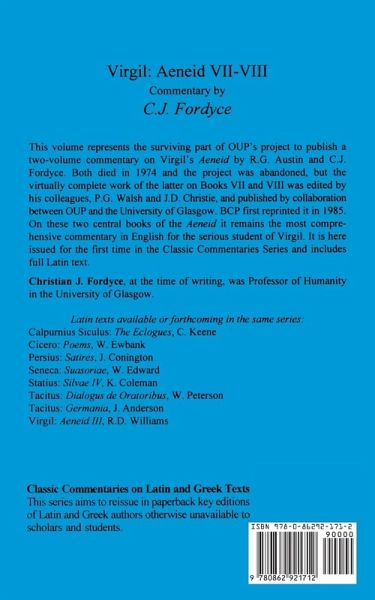
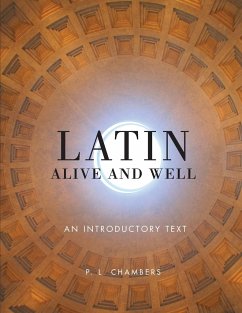
This book is the surviving part of the intended two-volume commentary on Virgil's Aeneid by R.G. Austin and C.J. Fordyce. The virtually complete work by Fordyce on Books VII and VIII was edited by his colleagues, originally published by OUP and the University of Glasgow. Of these two central books of the Aeneid, this remains the most comprehensive commentary in English for the serious student of Virgil. This edition includes the full Latin text with Latin-English vocabulary and notes in English. Classic Commentaries on Latin and Greek Texts series - re-issues in paperback key editions of Latin…mehr
This book is the surviving part of the intended two-volume commentary on Virgil's Aeneid by R.G. Austin and C.J. Fordyce. The virtually complete work by Fordyce on Books VII and VIII was edited by his colleagues, originally published by OUP and the University of Glasgow. Of these two central books of the Aeneid, this remains the most comprehensive commentary in English for the serious student of Virgil. This edition includes the full Latin text with Latin-English vocabulary and notes in English. Classic Commentaries on Latin and Greek Texts series - re-issues in paperback key editions of Latin and Greek authors otherwise unavailable to scholars and students. It in cludes Virgil: Aeneid III, edited by R.D. Williams.
Virgil (Publius Vergilius Maro, 70-19 BC) was born in the north of Italy and completed his education in Rome. Generally considered Rome's greatest poet, he wrote Eclogues, 37 BC, and Georgics, 29 BC. He then devoted the rest of his life to the composition of his greatest work, the epic poem the Aeneid. Virgil (Publius Vergilius Maro, 70-19 BC) was born in the north of Italy and completed his education in Rome. Generally considered Rome's greatest poet, he wrote Eclogues, 37 BC, and Georgics, 29 BC. He then devoted the rest of his life to the composition of his greatest work, the epic poem the Aeneid.
Inhaltsangabe
Introduction Bibliography Note On The Text Sigla Codicum Text I Commentary Appendix: Alliteration Indexes To The Notes (1) Index Nominum (2) Index Verborum (3) Index Rerum
Introduction Bibliography Note On The Text Sigla Codicum Text I Commentary Appendix: Alliteration Indexes To The Notes (1) Index Nominum (2) Index Verborum (3) Index Rerum
Es gelten unsere Allgemeinen Geschäftsbedingungen: www.buecher.de/agb
Impressum
www.buecher.de ist ein Internetauftritt der buecher.de internetstores GmbH
Geschäftsführung: Monica Sawhney | Roland Kölbl | Günter Hilger
Sitz der Gesellschaft: Batheyer Straße 115 - 117, 58099 Hagen
Postanschrift: Bürgermeister-Wegele-Str. 12, 86167 Augsburg
Amtsgericht Hagen HRB 13257
Steuernummer: 321/5800/1497
USt-IdNr: DE450055826