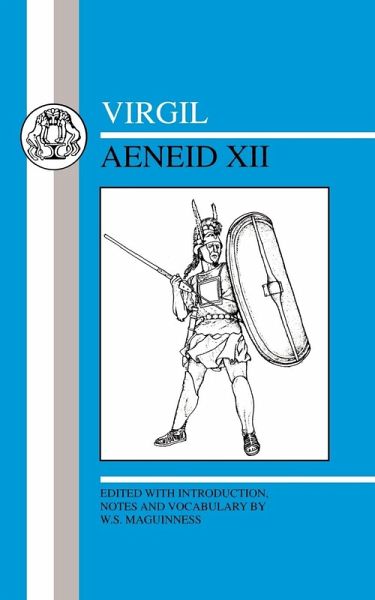
This edition, originally published in 1953 in the admirable Methuen Classical Texts series, has been in print ever since. It's longevity is deserved; for it remains a very fine edition, manageable at different levels of attainment. Maguinness had chiefly in mind students at sixth-form or early university level but, for the benefit of less practised students taking GCSE or in their second year of Latin bugun at University, he wisely included a Vocabulary (marked with syllable lengths to tie in with his very useful section on scansion and reading aloud) and a considerable amount of fairly…mehr
This edition, originally published in 1953 in the admirable Methuen Classical Texts series, has been in print ever since. It's longevity is deserved; for it remains a very fine edition, manageable at different levels of attainment. Maguinness had chiefly in mind students at sixth-form or early university level but, for the benefit of less practised students taking GCSE or in their second year of Latin bugun at University, he wisely included a Vocabulary (marked with syllable lengths to tie in with his very useful section on scansion and reading aloud) and a considerable amount of fairly elementary linguistic matter in the Notes. The Introduction gives an outline of the background knowledge needed by a beginner in Virgilian studies. For a succinct and always level-headed approach to the "Aeneid", this remains a splendid edition - one for which more advanced Virgilians still have every reason to be thankful; and Book XII gives an excellent flavour of the whole epic and the meaning of its constantly enigmatic closure.
Virgil (Publius Vergilius Maro, 70-19 BC) was born in the north of Italy and completed his education in Rome. Generally considered Rome's greatest poet, he wrote Eclogues, 37 BC, and Georgics, 29 BC. He then devoted the rest of his life to the composition of his greatest work, the epic poem the Aeneid. Virgil (Publius Vergilius Maro, 70-19 BC) was born in the north of Italy and completed his education in Rome. Generally considered Rome's greatest poet, he wrote Eclogues, 37 BC, and Georgics, 29 BC. He then devoted the rest of his life to the composition of his greatest work, the epic poem the Aeneid.
Inhaltsangabe
Introduction I. The Life And Works Of Virgil II. The Epic Tradition And The Aeneid III. Virgil's Poetry And The Modern Reader I IV. The Metre Of Virgil Bibliography Text Notes Index
Introduction I. The Life And Works Of Virgil II. The Epic Tradition And The Aeneid III. Virgil's Poetry And The Modern Reader I IV. The Metre Of Virgil Bibliography Text Notes Index
Es gelten unsere Allgemeinen Geschäftsbedingungen: www.buecher.de/agb
Impressum
www.buecher.de ist ein Internetauftritt der buecher.de internetstores GmbH
Geschäftsführung: Monica Sawhney | Roland Kölbl | Günter Hilger
Sitz der Gesellschaft: Batheyer Straße 115 - 117, 58099 Hagen
Postanschrift: Bürgermeister-Wegele-Str. 12, 86167 Augsburg
Amtsgericht Hagen HRB 13257
Steuernummer: 321/5800/1497
USt-IdNr: DE450055826